The Morning of the First Resurrection

Central to Latter-day Saint theology is the promise that those who are faithful to their covenants will rise on the Morning of the First Resurrection. My new illustration explores this event with a particular emphasis on covenant relationships and judgement.
Purchase physical prints or digital downloads of this piece if you would like to support my work.

There are a few themes and events in our theology and scripture that I find myself being drawn to again and again artistically. The deeper I delve into these subjects, the more I unearth. What I do find, I feel compelled to lay out on the page for others to explore.
This is how I feel about the doctrine of Resurrection. The restoration of the body, and its subsequent perfect immortality, is one of the most grand and inspiring promises of Christianity. We see glimpses of the resurrection in scriptural accounts of people being raised from the dead, but it is Christ's Resurrection that cements the doctrine and shines a light on humanity's future. And I can't help but be fascinated by it.
As you may remember, I previously explored this same concept in another illustration (below).
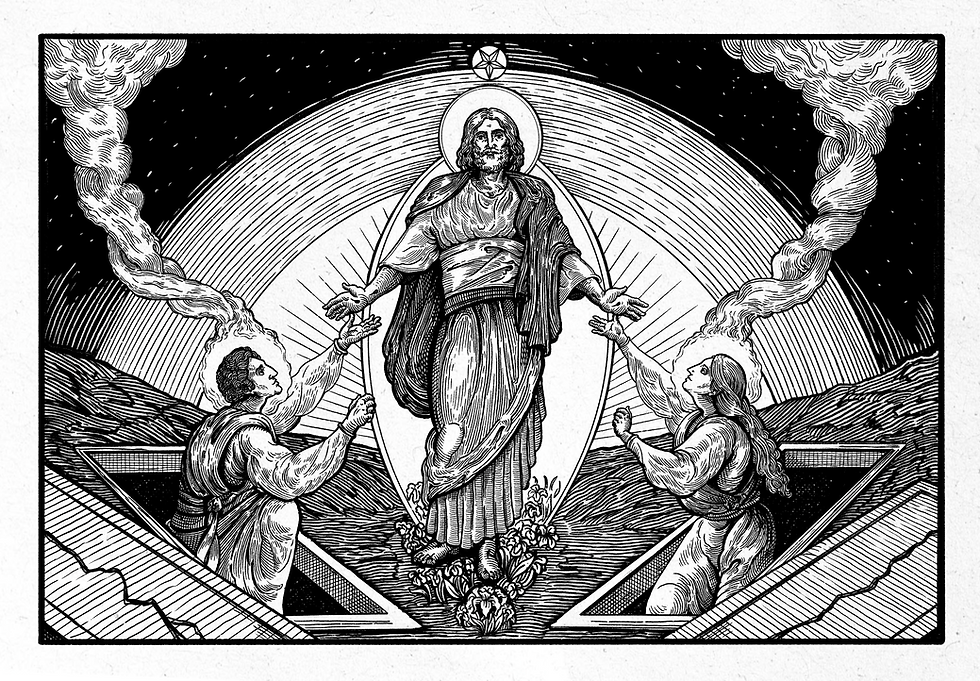
Contrasting these two pieces, I can see where my depth of knowledge has intersected with a bit more boldness in my symbolism. Over the past two years, I have developed a more confident approach to symbolism, baking it into light, composition, and framing. The new illustration does a better job, I feel, at bringing to life the Morning of the Resurrection in a compelling way.
In the rest of this article, I will break down my artistic decisions in a way that I hope illuminates the doctrine within.
The Morning Scene
I'll start first by describing the scene clearly presented in the illustration. Jesus Christ, up on a hill, is calling forth two individuals, a man and a woman, from their graves. As they emerge, the man and woman are in the act of putting on robes.
Throughout the scriptures, the image of a person putting on robes is associated with resurrection, as one puts on a new body.
Their hands are outstretched to the Lord, and His hands are outstretched down to them. The marks in His resurrected body are visible.
The Covenant Promise of Resurrection
My vision for this illustration first came to me as I was sitting in on my sister's sealing. As I heard the words of the accompanying blessing, I started to visualize the moment of Resurrection in the context of the marriage covenant. That is why I chose to show a man and a woman being resurrected together.
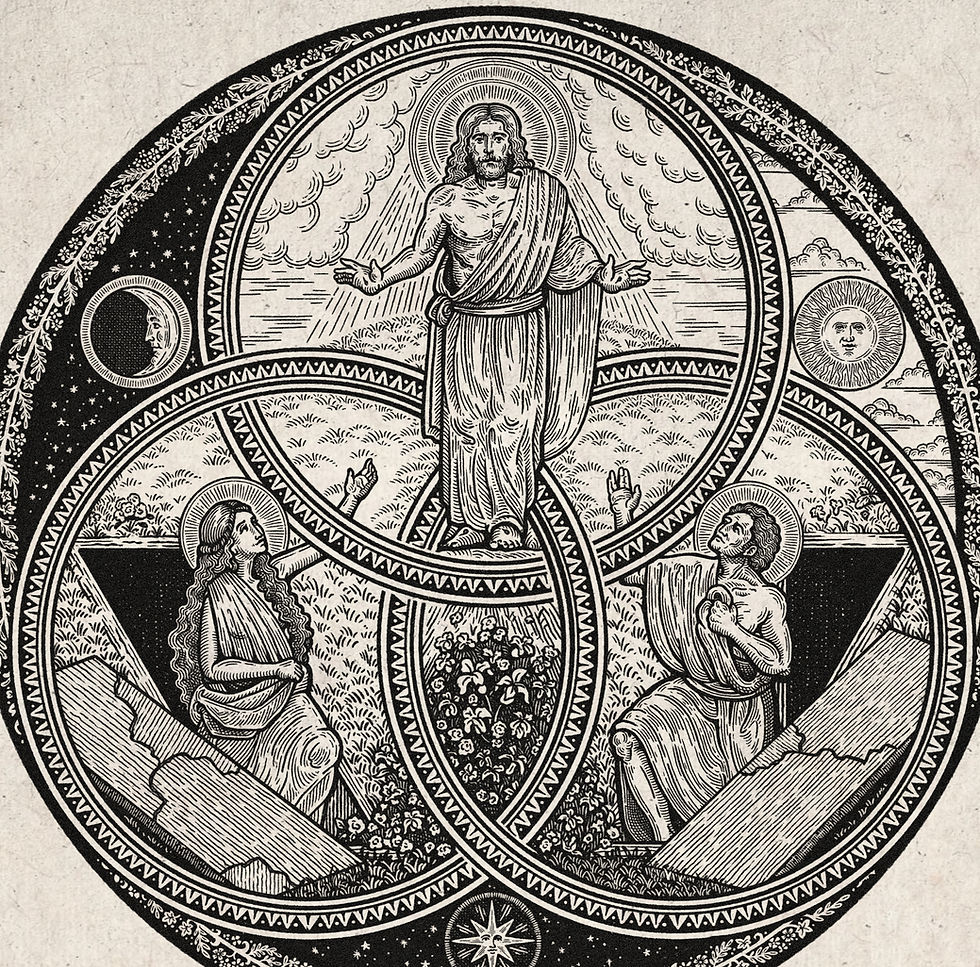
I wanted a way to represent the covenant relationships that are established in marriage, not just between the spouses, but between each spouse and the Lord, and all three together.
What I landed on were these three interlocking circles, each linking the individual within to the other two through covenant. In addition to being visually appealing, I felt it was symbolically appropriate as well.
In the spaces between the man/woman and the Lord, we see their hand outstretched to the Lord, waiting to be drawn from the grave and into their resurrected glory. These spaces act as a sort of threshold between two states.
In the space between the man and woman, we see a large growth of flowers, representing their seed and posterity—an important promise associated with their covenant.

Overall, we see a picture of the marriage union under Christ, where a man and woman bound together by covenant can look forward to the day they are called forth on the morning of the First Resurrection, with all the glorious inheritances associated with that promise.
There Are Three Glories
In the spaces between the three interlocking spheres, we find the Sun, the Moon, and a Star in their own circles. These three symbols serve a few different functions.
The first, and most significant is that these refer to the teachings of Paul. Paul spoke extensively about the Resurrection as a core of Christian doctrine. In 1 Corinthians 15, he lays out the concept of resurrected bodies inheriting different levels of glory by referring to the sun, moon, and stars.
There are also celestial bodies, and bodies terrestrial: but the glory of the celestial is one, and the glory of the terrestrial is another. There is one glory of the sun, and another glory of the moon, and another glory of the stars: for one star differeth from another star in glory. So also is the resurrection of the dead. It is sown in corruption; it is raised in incorruption: It is sown in dishonour; it is raised in glory: it is sown in weakness; it is raised in power.
—1 Corinthians 15:40-43
Paul is clearly teaching that resurrected bodies come in different degrees of glory, which are associated with the qualities of the person being resurrected. By extension, this presents the Resurrection as a kind of judgement itself. Those who are resurrected to more glorious bodies inherit a more glorious kingdom.
In Latter-day Saint theology, we quickly understand the Sun, Moon, and Star symbolism as associated with Kingdoms of Glory. These restored truths unveil the mystery of the afterlife, laying out that beautiful Plan of Salvation which affords each person an eternal glory commensurate with the glory they wish to obtain.
It felt fitting, then, that these three symbols be so prominent in an illustration of the Resurrection as a reminder of the gradation of glory that will be observed in those who are resurrected.
The second function of the sun and moon specifically is to set the scene. The sun rises in the East, while the moon sets in the West, reminding the viewer that this is specifically the morning of the First Resurrection.

The final function of the sun and moon is to identify the male and female attributes in contrast (which is totally separated from the sun and moon as representing degrees of glory).
In traditional symbolism, the sun, with all its heat and vigor, represents the masculine aspect. While the moon, soft and gentle, represents the feminine aspect. This is why the man is next to the sun while the woman is next to the moon in my illustration.
Lastly, I want to note that I chose to give each of these symbols that classic personification you find in medeival illustrations. In the context of people being restored to glories like unto the Sun, Moon, and Stars, it felt fitting to give these each a bit of personification.
One Eternal Round
You'll notice that the entire illustration is contained within one larger circle, the boundary of which is marked by a vine from which all sorts of flowers and leaves spring. To me, the floral symbolism captured the idea of the fruits of life, the return to Eden, and the future state of perfect abundance.
The circle itself represents the concept of eternity, that the course of the Lord is indeed "one eternal round", as Nephi and Alma taught.
Eternity has no beginning or end, and as we are eternal beings, we too have no beginning or end. All our lives, including our divine potential to become like God, are circumscribed in that great eternal round. We will march on and on, united by covenant with our spouses to the Lord, into that great eternal glory.
That is the great and ultimate promise of the Resurrection: There is no end to Glory!
As Above, So Below
The final thing I wanted to note was the hidden layer of composition in my illustration.
If you overlay the piece with six-sided star, the elements line up very neatly.
The three interlocking circles meet the outer ring at the same point where they meet the triangle points. The three celestial bodies are neatly nestled in the inner angles of the opposite triangle. Jesus' outstretched hands lie on one line, and the inner angle of the open graves lie on two others. The two heads of the man and woman are nested in the intersecting angles, and the head of Christ is in the upper angle. These lines and angles follow the general motion of the figures in a way that guides you around the composition.

This was done intentionally, because not only does it provide the composition with a very visually appealing structure, it also refers to the idea of "As Above, So Below". Earth is modelled after heaven. Our mortal bodies are modelled after our immortal bodies. Everything operates on principles of opposition and correspondence.
Support My Work
If you like this piece, please consider supporting me by purchasing a physical print or digital download. Every purchase helps me dedicate more time to these projects, and so I am sincerely grateful.
I plan to do more of these thoughtful, time-intensive pieces moving forward. They are a labor of love and represent my deep interest in the doctrines of Christ.
I appreciate all of your encouragement and patience as I carry on, and I can't wait for you to see what I have coming next.


Thank you for doing this and explaining the symbolism! Masterfully done and explained! The flowers in the lower middle remind me of the fine details in the Ghent Alterpiece.